
Table of Contents
Introduction
In the Indian ethnic wear business, the product you sell is only as good as the manufacturer behind it. A manufacturing partner who delivers consistent quality, trend-driven designs, and reliable dispatch turns your store or brand into something buyers trust and return to. A partner who underdelivers on any of these dimensions creates problems that compound quietly until they are no longer quiet.
India’s ethnic wear market is growing fast. The segment is valued at over USD 22 billion domestically, with export demand from NRI communities and international fashion buyers adding a further and rapidly expanding dimension. Wholesalers, boutique owners, D2C brands, and exporters all operate in this space, and all of them face the same foundational challenge: finding a manufacturing partner whose quality, design capability, and reliability can be trusted across every order, every season, and every year.
This guide is built to help you make that decision correctly. It covers every evaluation criterion that matters, the red flags that signal a manufacturer you should avoid, and a clear framework for matching the right type of manufacturer to your specific business model.
Geetha Textile has operated as a trusted Indian ethnic wear manufacturer and exporter from Surat since 1997. This guide reflects 25 years of understanding what reliable ethnic wear manufacturing actually requires, from both the manufacturer and the buyer’s perspective.
Why the Manufacturing Partner Decision Defines Your Business
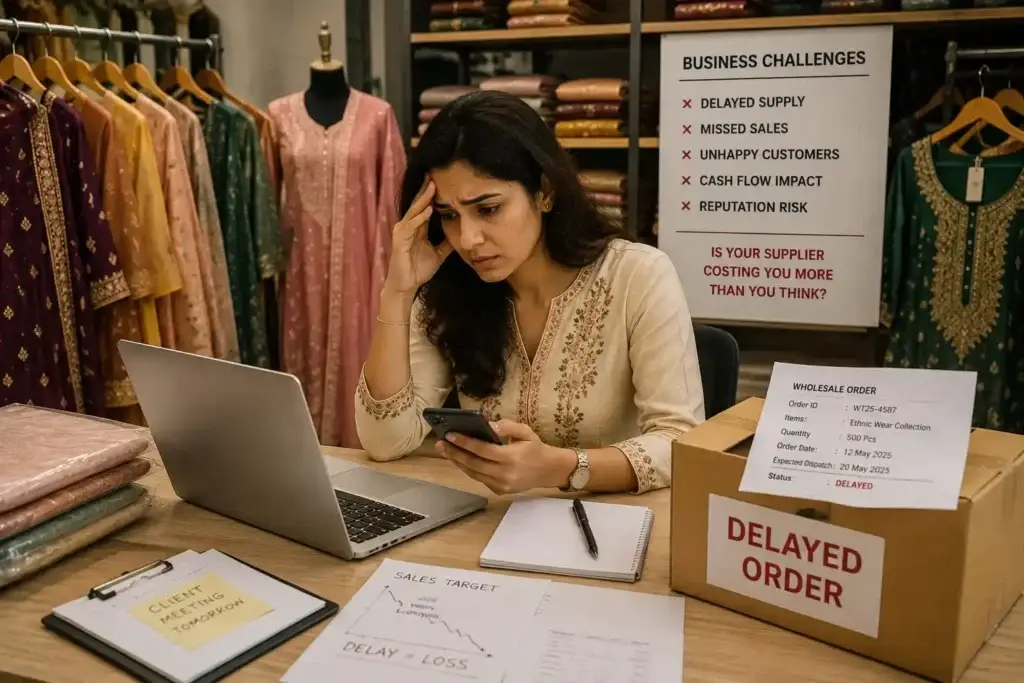
A wholesale clothing business, a boutique, or an export label does not sell garments. It sells the quality, the design, and the reliability that its manufacturer produces. When the manufacturer performs well, the business builds a reputation that earns loyal buyers and repeat orders. When the manufacturer underperforms, that reputation is the first casualty.
The ethnic wear category is particularly unforgiving because it is driven by occasion. A saree ordered for a wedding season must arrive on time, look exactly as represented, and hold its quality through the event. A kurti collection purchased for a festive season must reflect current trends, finish cleanly, and move quickly off retail shelves. There is no room for quality inconsistency or delayed dispatch when your buyers are depending on your stock for time-sensitive occasions.
Choosing the right ethnic wear manufacturing partner is therefore not a logistical decision. It is a strategic one. It determines the range you can offer, the margin you can achieve, the delivery promises you can make, and the long-term trajectory of your business.
Your manufacturing partner is not a vendor. They are the foundation of your product quality, your brand promise, and your buyer relationships. Choose them with the same care you apply to every other strategic business decision.
The Indian Ethnic Wear Manufacturing Landscape in 2026
India is the world’s leading producer of traditional ethnic garments and fabrics, with a textile industry valued at over USD 220 billion. The ethnic wear segment within this landscape is characterised by rich regional diversity, different states and cities lead in different product categories and craft traditions, and understanding this geography helps buyers find the right manufacturing partner faster.
Jaipur leads in block print and hand-embroidered ethnic wear. Tirupur specialises in knitwear and casual ethnic fusion. Delhi and its surrounding areas produce a wide range of women’s ethnic garments, including suits and party wear. And Surat, Gujarat, is the dominant manufacturing hub for sarees, kurtis, suits, and synthetic fabric-based ethnic wear at production scale.
Why Surat Is the Centre of Indian Ethnic Wear Production
Surat’s dominance in ethnic wear manufacturing is structural, not accidental. The city hosts one of the world’s most concentrated clusters of textile production expertise, with integrated weaving, dyeing, printing, embroidery, stitching, and finishing capabilities operating in close geographical proximity. This integration means faster turnaround, lower logistics costs at each production stage, and a workforce trained specifically in the craft traditions that define Indian ethnic wear quality.
For buyers sourcing sarees, kurtis, suits, and co-ord sets at wholesale scale, Surat’s manufacturing ecosystem offers unmatched breadth of design, depth of production capacity, and competitive pricing relative to quality. Geetha Textile’s manufacturing facility in Sayan, Surat, spanning 60,000 square feet with an integrated fibre-to-fashion production setup, is built within this ecosystem, drawing on its full depth of capability for every order.
Define What Your Business Actually Needs Before Searching
The most expensive sourcing mistake is beginning a manufacturer search without clearly defining what your business requires. Unclear requirements produce misaligned conversations, wasted sample costs, and manufacturing partnerships that fail within the first season because the expectations were never properly established.
Product Category Clarity
Indian ethnic wear covers an enormous range: sarees, kurtis, salwar suits, lehengas, co-ord sets, dupattas, festive wear, and bridal garments. Not every manufacturer is equally capable across all categories. Some excel in saree production with sophisticated weaving and printing capabilities. Others are strongest in kurti and suit manufacturing with skilled cutting and stitching teams. Identify your primary product categories before evaluating manufacturers, and verify their specific capability and quality level in those categories through samples.
Geetha Textile’s production capability spans sarees, kurtis, salwar suits, and co-ord sets — a breadth that allows buyers to source across multiple ethnic wear categories from a single trusted manufacturing partner, eliminating the coordination complexity of managing multiple suppliers.
Volume, Order Frequency, and MOQ Tolerance
Your order volume and frequency profile determines which manufacturer types are appropriate for your business. Large manufacturers with high-volume production facilities may require minimum order quantities that are too large for a boutique or early-stage D2C brand. Small manufacturers with flexible MOQ may not have the production capacity to fulfil large wholesale or export orders consistently.
Be specific with yourself about your realistic order quantities before approaching manufacturers. If you are building a boutique with 50 to 100 pieces per style, your needs differ significantly from a wholesale distributor placing 500 to 1,000 pieces per design. Geetha Textile serves both profiles through its flexible ordering structure and ready-to-dispatch inventory, accommodating buyers at different scales of operation.
Lead Time Requirements and RTD Stock Needs
Ethnic wear demand is highly seasonal and occasion-driven. Wedding seasons, Navratri, Diwali, Eid, and regional festivals create sharp peaks in demand that require either short manufacturing lead times or access to ready-to-dispatch inventory. Understand your own demand cycle and ensure any manufacturer you evaluate can reliably serve your peak season requirements, not just your off-season orders.
7 Criteria That Separate Reliable Manufacturers from the Rest
These seven criteria are the evaluation framework every buyer should apply before committing to any ethnic wear manufacturing partner. Each addresses a dimension of reliability that commonly fails in practice.
1. Integrated Manufacturing Capability
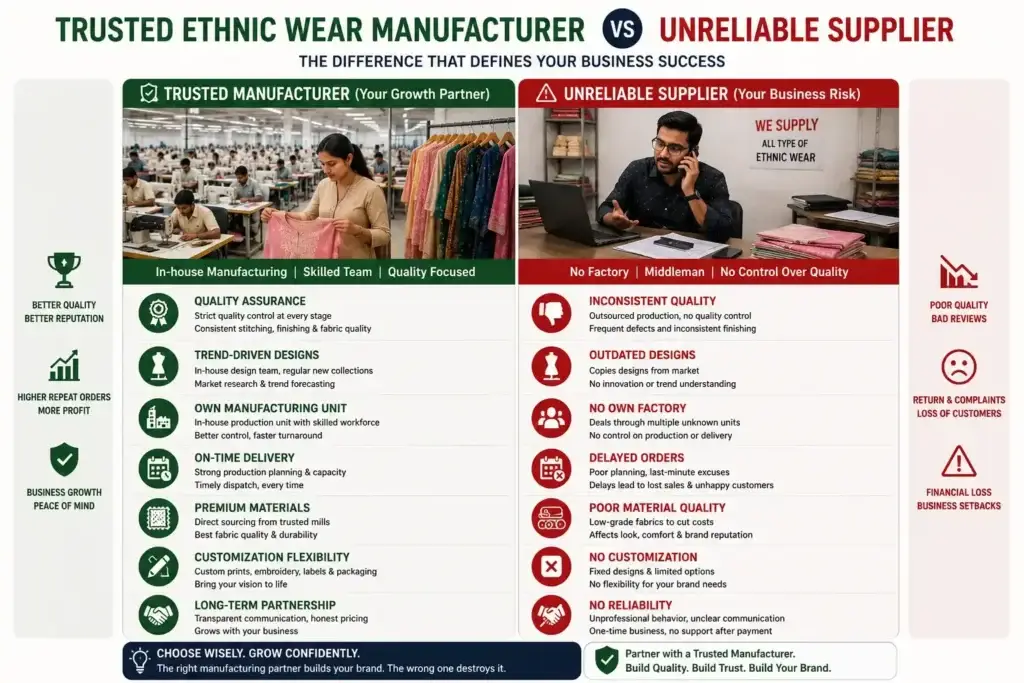
1. What to look for A manufacturer who controls every stage of their production process, from fabric preparation through to finished, packed garment, delivers more consistent quality and faster turnaround than one who outsources critical stages to third parties. Ask specifically: is weaving, dyeing, printing, cutting, stitching, and finishing all done in-house? What is the total production capacity per month? Integrated manufacturers have fewer quality break points and stronger accountability for every stage of the process.
2. Design Capability and Seasonal Collection Depth
2. What to look for In ethnic wear, design quality is often the primary commercial differentiator. Your buyers choose your store over competitors based on the distinctiveness and trend relevance of your collection. Your manufacturing partner’s design team and seasonal collection development capability directly determines this. Ask to see their latest seasonal collection, understand how frequently new designs are released, and evaluate whether their design language matches your target market’s aesthetic expectations.
3. Quality Control Systems and Finishing Standards
3. What to look for Quality in ethnic wear is assessed across multiple dimensions: fabric quality, colour fastness, stitching consistency, embellishment security, finishing precision, and packaging presentation. Ask the manufacturer to describe their quality control process specifically: what is checked at each production stage, what are the tolerance parameters, and how are rejected pieces handled. A manufacturer with genuine QC systems answers these questions with operational specifics. Always validate quality claims through samples from multiple production runs before bulk order commitment.
4. Certifications and Compliance
4. What to look for Certifications confirm that a manufacturer’s operations meet documented quality and ethical standards. Relevant certifications for Indian ethnic wear manufacturers include ISO quality management certification, OEKO-TEX standard for fabric safety, and export-related compliance documentation for international buyers. A manufacturer who displays certifications openly and can provide documentation on request is one who operates to defined standards rather than variable informal practices.
Geetha Textile: Geetha Textile’s certifications and compliance standards are documented at geethatextile.com/certifications-compliance/ — accessible to any buyer conducting due diligence before partnership.
5. Delivery Reliability and RTD Stock Availability
5. What to look for Delivery reliability is where many manufacturers fail the buyers who trusted them. Ask for specific lead time commitments by product category and verify through references from existing buyers who have placed repeat orders. For buyers with time-sensitive requirements, also ask about ready-to-dispatch inventory availability. A manufacturer with both made-to-order capability and an RTD collection serves the full range of your sourcing needs, from advance seasonal planning to urgent stock replenishment.
6. Customisation and Private Label Support
6. What to look for For D2C fashion brands, boutiques building a signature style, and resellers wanting exclusive designs, customisation capability is a critical differentiator. Verify the manufacturer’s ability to develop custom designs to your specifications, accommodate your branding on labels and packaging, and maintain confidentiality on designs produced exclusively for your brand. This is the foundation of a private label ethnic wear partnership, and it requires explicit agreement rather than implied understanding.
7. Communication, Transparency, and Long-Term Partnership Mindset
7. What to look for The quality of a manufacturer’s communication during your initial inquiry predicts the quality of their communication when problems arise during production. Evaluate how specifically and promptly they respond to your requirements. Manufacturers who ask precise clarifying questions, provide written quotations without prompting, and communicate proactively about sample timelines are demonstrating the operational culture that makes a long-term partnership work.
Red Flags That Signal an Unreliable Manufacturing Partner
Experienced buyers develop instincts for identifying unreliable manufacturers early. For buyers newer to B2B ethnic wear sourcing, these warning signs demand immediate caution.
Warning: Sample quality that does not match bulk production. This is the most commonly reported problem in Indian ethnic wear B2B sourcing and the most expensive to discover after the order is placed. Always specify in your purchase order that bulk quality must match the approved sample within stated tolerances, and build a receiving quality check into every delivery.
Warning: No physical manufacturing facility or verified production address. A manufacturer who cannot confirm a verifiable production facility address, or who deflects requests for a factory visit or video tour, is likely a broker presenting themselves as a manufacturer. The pricing may look attractive but the supply chain control and quality consistency will not be.
Warning: Prices significantly below comparable manufacturers for the same quality specification. In ethnic wear manufacturing, labour, fabric, and embellishment costs are relatively transparent. A price substantially below market for a stated quality level almost always means either the quality is different from what is represented, or the manufacturer is an intermediary adding their margin on top of another manufacturer’s price.
Warning: Vague or evasive answers to specific production questions. A manufacturer who cannot answer specific questions about their production capacity, quality control process, or delivery lead time with operational specifics is not operating the kind of manufacturing business you can build a reliable supply chain on.
Warning: No written documentation offered as standard practice. Professional ethnic wear manufacturers provide written quotations, sample approval records, purchase order confirmations, and dispatch documents as a matter of course. Operating entirely on verbal agreements and messaging apps is a sign of an informal arrangement that creates significant commercial risk for the buyer.
Export Buyers : What You Need to Verify Before You Commit
For international buyers sourcing Indian ethnic wear, the evaluation criteria above all apply, with several additional verification requirements specific to export transactions.
Certification for international market compliance. Buyers in markets with strict import standards require documentation confirming fabric safety, ethical production, and where specified, sustainability credentials. Verify that the manufacturer holds and can provide relevant export certifications before placing an order.
Quality consistency across large production runs. Export orders typically involve higher volumes per design than domestic wholesale orders. Quality consistency across 500 to 1,000 pieces of the same design requires a manufacturing infrastructure and QC system of a different scale than that required for smaller domestic runs.
Export packaging and documentation capability. Export-ready manufacturers understand the packaging standards, labelling requirements, and documentation protocols needed for international shipment. Verify that the manufacturer has existing export experience to the countries you are targeting, not just a claimed willingness to export.
Geetha Textile exports Indian ethnic wear to 12-plus countries across the globe, with established export documentation processes, export-ready packaging standards, and quality consistency infrastructure built specifically for the demands of international buyers. Our certifications and compliance credentials are available for review by any export buyer conducting due diligence.
RTD Stock vs Made-to-Order : Which Model Serves Your Business?
One of the most practically important decisions in ethnic wear sourcing is choosing between a ready-to-dispatch model and a made-to-order model. The right choice depends on your business model, your demand cycle, and your capital position.
Ready-to-dispatch (RTD) stock refers to finished, packaged ethnic wear that the manufacturer has produced in advance and can ship within 24 to 48 hours of order confirmation. RTD stock is ideal for retailers and boutique owners who need to respond quickly to seasonal demand peaks, replenish fast-selling designs without waiting for production cycles, or access premium designs with limited inventory availability.
Made-to-order (MTO) production involves placing an order for garments that are manufactured specifically to your requirements after order confirmation. MTO is ideal for larger wholesale buyers with defined seasonal planning cycles, D2C brands building signature collections with custom specifications, and export buyers who need specific quality standards or custom labelling across bulk quantities.
Many experienced ethnic wear buyers use both models strategically: RTD stock for quick-turn volume and seasonal replenishment, MTO for core collection planning and custom development. A manufacturing partner who supports both models gives your business maximum sourcing flexibility.
Geetha Textile’s ready-to-dispatch collection offers premium ethnic wear available for 24 to 48 hour dispatch with no minimum MOQ on select items, alongside full made-to-order and custom manufacturing capability for buyers planning their collections in advance.
Building a Long-Term Manufacturing Relationship
The ethnic wear B2B market rewards long-term manufacturing relationships disproportionately. A manufacturer who knows your quality expectations, your design preferences, your seasonal timing, and your buyer profile produces better results at lower friction than any new relationship regardless of its initial quality.
Building this relationship requires investment from the buyer’s side as well. Place trial orders before bulk commitments. Provide specific, constructive feedback after receiving your first orders. Communicate your seasonal planning calendar so the manufacturer can allocate production capacity appropriately. Pay on agreed terms consistently. These behaviours signal to the manufacturer that you are a serious, long-term partner worth investing their best resources and priority capacity in.
The manufacturers who are worth building long-term relationships with respond to this investment by prioritising your orders during peak seasons, accommodating your specific design development requests, and communicating proactively about anything that might affect your supply. This level of partnership is the difference between a supply chain that works and one that merely functions.
Geetha Textile’s 500-plus regular clients include wholesalers, boutique owners, and garment exporters who have maintained active partnerships for multiple years. Long-term relationships are the foundation of their business model, not the exception.
Why Geetha Textile Is the Ethnic Wear Manufacturing Partner Your Business Deserves
Geetha Textile has manufactured and exported Indian ethnic wear from Surat since 1997. Over 25 years, the business has grown from a regional manufacturer to an integrated fibre-to-fashion production facility serving 500-plus regular clients across India and 12-plus countries globally. The numbers are significant: 60,000 square feet of integrated manufacturing and warehousing in Sayan, Surat, 1 million-plus metres of fabric produced and delivered annually, 5,000-plus designs developed across ethnic categories, and 100-plus skilled professionals including weavers, designers, and quality controllers.
What these numbers represent practically is a manufacturer with the capacity, the design depth, and the quality infrastructure to serve every buyer type in this guide’s target audience. Wholesalers and distributors benefit from consistent volume production and flexible ordering. Boutique owners and retailers access trend-driven design collections and RTD stock for seasonal agility. D2C fashion brands and private label buyers work with Geetha Textile’s design team on custom collection development. Export buyers rely on the manufacturer’s certified, compliant, export-documented production capability.
The full range of ethnic wear manufactured at Geetha Textile spans sarees, kurtis, salwar suits, and co-ord sets, each produced with the same quality standard and the same design commitment. Certifications and compliance documentation are accessible to all buyers conducting due diligence. Our authorized partner programme provides a structured pathway for wholesalers and distributors looking to formalise their sourcing relationship with Geetha Textile.
Conclusion : The Right Partner Builds Your Business
Finding the right ethnic wear manufacturing partner is not a task with a quick shortcut. It requires clarity about your own business needs, rigorous evaluation of potential manufacturers against criteria that matter, and the patience to test before committing at scale.
The seven criteria in this guide, integrated manufacturing capability, design depth, quality control, certifications, delivery reliability, customisation support, and communication quality, represent the complete picture of what a reliable ethnic wear manufacturing partner looks like in practice. Apply all seven before placing your first significant order with any manufacturer. The time invested in this evaluation will be returned many times over in the consistency, quality, and reliability of the supply relationship you build.
The Indian ethnic wear market in 2026 offers buyers extraordinary opportunity. The manufacturers who help you capture that opportunity are the ones who match the criteria in this guide. And for over 25 years, Geetha Textile has been that manufacturer for hundreds of businesses across India and the world.
Frequently Asked Questions
Quality consistency across repeated orders is the most important factor. A manufacturer who delivers excellent quality on a sample or first order but cannot maintain that standard across bulk production will cost you clients, reputation, and business. Evaluate quality control systems specifically, and verify consistency through samples from multiple production batches before committing to bulk orders.
Request their latest seasonal collection catalogue and ask how frequently new designs are released. Evaluate whether their design language reflects current market trends. Ask about their in-house design team and their process for custom design development. A manufacturer with genuine design capability will have a structured seasonal design process, a portfolio of distinctive designs, and a clear process for custom collection development.
MOQ varies significantly depending on the manufacturer's scale and business model. Large integrated manufacturers may require higher MOQs for made-to-order production. Manufacturers who also carry ready-to-dispatch stock often offer lower or no MOQ on RTD items. Always clarify MOQ requirements early in your manufacturer evaluation, and choose a manufacturing partner whose MOQ structure aligns with your actual order volume capacity.
Request a physical facility address and arrange a factory visit or video tour. Verify that they can describe their in-house production process in specific operational terms. Ask for references from existing buyers who have placed multiple repeat orders. A legitimate manufacturer welcomes this scrutiny. A broker presenting themselves as a manufacturer will deflect or provide vague answers to these questions.
Export buyers typically look for ISO quality management certification, OEKO-TEX fabric safety certification, and where relevant, sustainability certifications like GOTS or GRS. Manufacturers exporting to specific markets may also need compliance documentation for those markets' import requirements. Always verify that the manufacturer can provide actual documentation rather than claimed certification.
Surat is India's dominant manufacturing hub for sarees, kurtis, suits, and synthetic fabric-based ethnic wear. The city's integrated manufacturing ecosystem provides advantages in design variety, production capacity, quality of skilled labour, and competitive pricing relative to quality that other Indian cities cannot match for these specific product categories. Surat-based manufacturers also typically have shorter lead times because multiple production stages are available within a compact geographic cluster.
Contact the Geetha Textile team through geethatextile.com/contact-us/, call or WhatsApp at +91 99090 02028, or email geethacreation52@gmail.com. The team will discuss your specific product requirements, volume, timeline, and customisation needs and guide you through the sample and bulk order process. Ready-to-dispatch stock is available for 24 to 48 hour dispatch on select items for buyers with urgent requirements.