
Table of Contents
Introduction
Finding reliable kurti manufacturers in India is one of the most important sourcing decisions a retailer or wholesaler will make. Get it right, and your supply chain becomes a genuine competitive advantage. Get it wrong, and every production cycle becomes an exercise in damage control.
India is home to thousands of kurti manufacturers, and the variation in quality, reliability, and business integrity across that landscape is enormous. For boutique owners, wholesalers, online sellers, and exporters, the choice of manufacturer is not simply about finding the lowest price per piece. It is about finding a production partner whose consistency, transparency, and capability can genuinely support your business over time.
Most articles on this topic hand you a list of company names and stop there. This guide goes further. It gives you a practical evaluation framework, a clear method for verifying who you are actually dealing with, the red flags that experienced buyers know to watch for, and a segment-by-segment sourcing guide tailored to your specific business model.
At Geetha Textile, we have been among the leading kurti manufacturers in India since 1997, supplying wholesalers, boutiques, and exporters across India and 12-plus countries from our integrated facility in Surat, Gujarat. Everything in this guide reflects what we have learned about what B2B sourcing actually requires.
Why Where You Source Is as Important as What You Source
When your business depends on consistent quality and on-time delivery, a manufacturing partner who misses either of those is not just an inconvenience. In the kurti segment, where trend cycles are short and seasonal windows are narrow, a supplier who cannot deliver what was agreed, when it was agreed, represents a direct threat to your revenue and your client relationships.
India’s ethnic wear market is projected to cross INR 2.5 lakh crore by 2030, according to Invest India, with kurtis remaining the single largest garment category within it. The demand is consistent, the growth is strong, and the sourcing opportunity is real. But capturing that opportunity requires a supply chain that starts with the right kurti manufacturers in India, not just the most convenient or the most visible ones.
The sourcing decision is a strategic business decision. The right kurti manufacturer gives you predictable quality, transparent pricing, and a production partner who is built to grow with your business. The wrong one gives you compounding problems with every order that follows the first one.
The right kurti manufacturer in India does not just supply product. They supply confidence. And confidence is what your buyers are paying for when they choose your brand.
India's Kurti Manufacturing Landscape: Where Quality Actually Lives
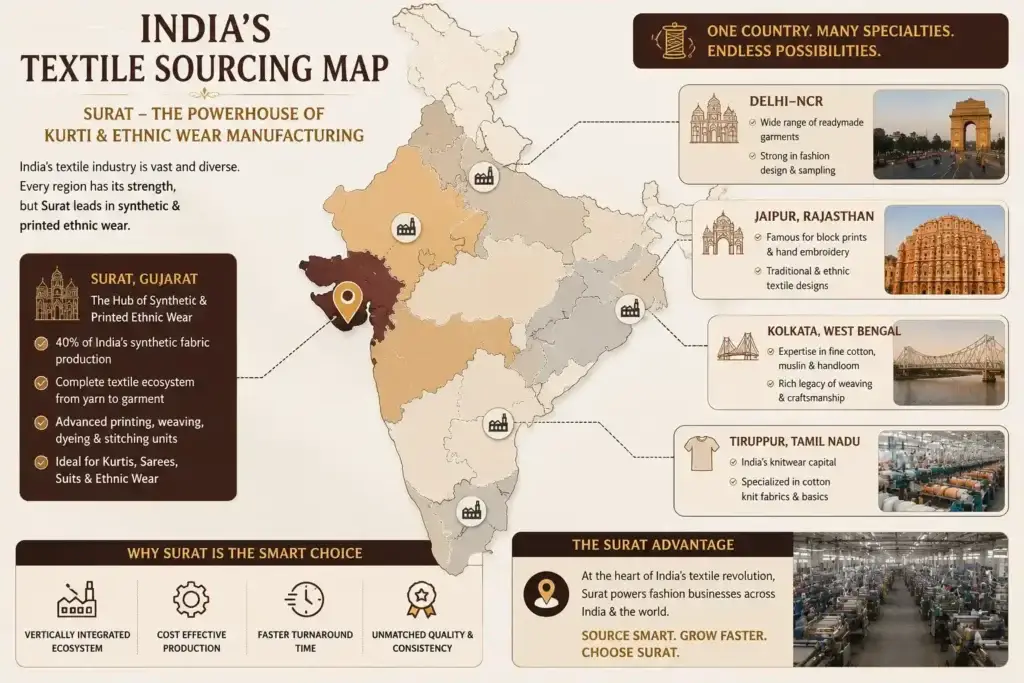
India’s textile manufacturing ecosystem is geographically concentrated by specialisation. Tiruppur in Tamil Nadu dominates cotton knitwear. Jaipur is known for block-print and Jaipuri-style fabrics. Kolkata leads in fine cotton and muslin weaves. And Surat, Gujarat, stands apart as the undisputed centre of synthetic and printed ethnic wear manufacturing, which is the category that defines the modern kurti market.
Why Surat Is the Centre of Kurti and Ethnic Wear Manufacturing
Surat is not simply a large textile city. It is the most vertically integrated textile production cluster in India for synthetic, printed, and blended ethnic wear. The city processes an estimated 40 percent of India’s total synthetic fabric output and houses the complete supply chain, from yarn and weaving to dyeing, printing, stitching, and dispatch, within a single geographic area. When a kurti manufacturer in India is based in Surat, they are operating at the source of the raw material chain that supplies the rest of the country’s ethnic wear industry.
This geographic advantage translates directly into faster production cycles, more competitive pricing, and better access to the latest fabric developments. Geetha Textile’s manufacturing facility in Sayan, Surat is a 60,000 square foot fibre-to-fashion operation that places us at the heart of this ecosystem. From the raw fabric to the finished, dispatch-ready garment, every production step happens under our roof and within our quality control system.
Manufacturer, Wholesaler, or Broker: Who Are You Really Buying From?
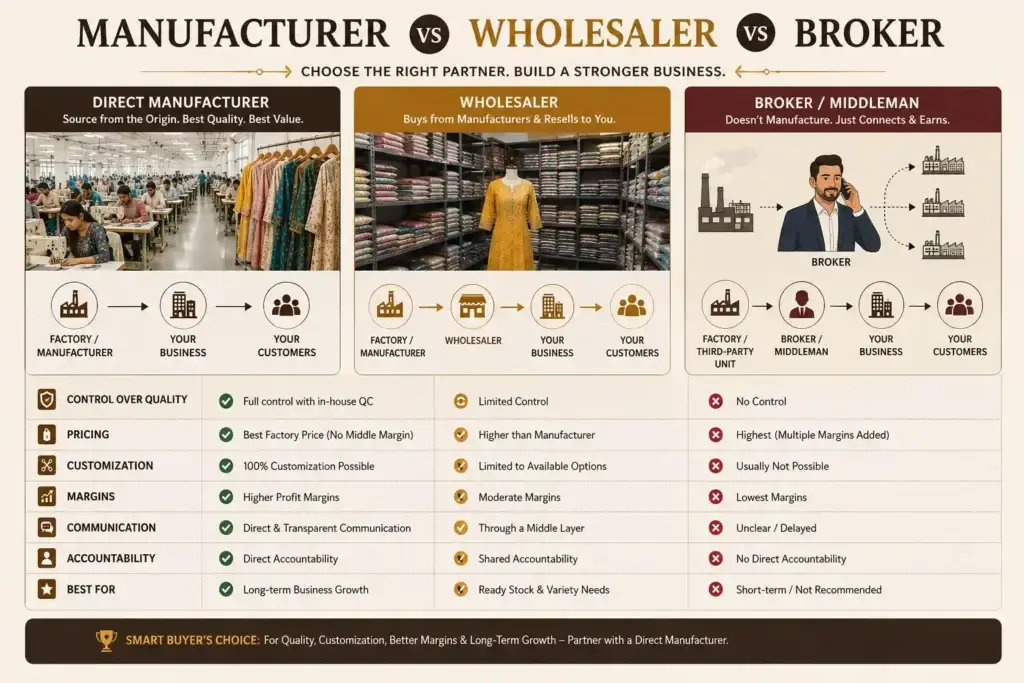
This is the most consequential distinction in B2B kurti sourcing, and it is the one that most buyers discover too late. The Indian kurti supply chain has three primary supplier types, and understanding the difference between them protects you from the most common and most expensive sourcing mistakes.
A direct manufacturer produces kurtis in their own facility using their own raw materials, design team, and production processes. You are sourcing from the origin point of the supply chain. Quality control is in-house. Pricing is at factory level. Customisation is genuinely possible. This is the ideal sourcing partner for any serious B2B buyer looking to build a long-term kurti supply relationship.
A wholesaler purchases finished kurtis from one or more kurti manufacturers in India and resells them at a margin. They may offer wider variety and faster access to ready stock, but they cannot offer custom production, have no direct control over quality, and always add a cost layer between you and the factory floor. For buyers who prioritise variety over customisation, wholesalers can serve a function, but margins are tighter and quality consistency is less guaranteed.
A broker presents themselves as a manufacturer but operates without any production facility of their own. They place your order with third-party units and take a coordination margin. Sample quality frequently does not reflect bulk quality because the broker is sourcing from whatever capacity is available at the time of the order. This is the highest-risk supplier type in the kurti industry and unfortunately the hardest to identify without asking the right questions upfront.
How to verify: Ask for the supplier’s physical facility address and request a factory visit or video walkthrough. Ask specifically: What is your in-house monthly production capacity? A genuine kurti manufacturer in India answers with specific operational details. A broker answers with marketing language.
7 Things to Evaluate Before Partnering with Any Kurti Manufacturer in India
1. In-House Manufacturing vs. Third-Party Sourcing
2. Design Range and Trend Responsiveness
A strong kurti manufacturer does not only produce what you specify. They anticipate what the market wants next. Ask how frequently they launch new designs, whether they have an in-house design team, and whether they can share recent seasonal lookbooks or collection catalogues. A manufacturer with genuine design capability adds commercial value to your sourcing relationship beyond the garment itself.
Geetha Textile’s in-house design team has developed over 5,000 fabric designs across ethnic wear categories, with new collections released in alignment with seasonal market trends and the buying preferences of our clients across India and internationally.
3. Fabric Quality and Material Sourcing
The quality of a kurti is determined before a single stitch is placed. Ask your manufacturer where they source their fabric, what GSM ranges they typically work with, and how they test fabric quality before cutting begins. A vertically integrated kurti manufacturer in India who controls fabric sourcing internally will consistently deliver greater batch-to-batch quality than one who depends on third-party fabric suppliers with variable standards.
4. MOQ Flexibility and Bulk Pricing Transparency
Minimum order quantities define which manufacturers are realistically accessible for your order volume. A large integrated mill with a 5,000-piece minimum per design is not the right sourcing partner for a boutique placing a 200-piece initial order. Confirm MOQ per design and per season clearly, and ensure all pricing components are disclosed upfront, including stitching, finishing, packaging, and freight charges. Hidden charges at the invoice stage are a consistent indicator of a manufacturer who does not manage buyer relationships with transparency.
Geetha Textile’s Ready-to-Dispatch kurti collection carries no minimum MOQ for select styles, making it directly accessible for boutiques and newer buyers who want to test quality before committing to full bulk production runs.
5. Quality Control and Certifications
Ask the manufacturer to describe their quality control process in step-by-step operational terms, not as a general quality claim. Which parameters are inspected at each production stage? What is the rejection threshold, and how are rejected pieces handled before dispatch? Does the manufacturer carry any compliance certifications relevant to your target market?
Geetha Textile’s certifications and compliance page documents the quality and ethical standards that wholesale and export buyers require. Every garment leaving our facility is quality-checked against defined acceptance criteria before it is dispatched to any client.
6. Dispatch Speed and Delivery Reliability
Retail buying cycles are seasonal and time-sensitive. A kurti manufacturer in India who cannot deliver on schedule during the Navratri buying season or the pre-wedding collection window is a business liability regardless of how good their product looks in a catalogue. Ask for typical lead times from order confirmation to dispatch, request references from existing clients who can speak to delivery performance across multiple orders, and clarify what their process is for communicating production delays when they occur.
Geetha Textile’s Ready-to-Dispatch collection ships within 24 to 48 hours from our Surat warehouse, giving buyers with time-critical orders a reliable, fast-turnaround option without any compromise on quality standards.
7. Customisation and Private Label Support
If your brand requires kurtis produced to your specific designs, your labels, or your sizing specifications, confirm that the manufacturer genuinely supports custom production with a documented process. This means a structured design intake, sample approval before bulk production begins, and clear agreements on design ownership and confidentiality. Many kurti manufacturers in India claim customisation capability but have no structured process to deliver it reliably across multiple orders.
Apply all seven criteria before placing your first bulk order. A genuine kurti manufacturer in India will answer every question with specific, operational detail. A supplier without the systems to support a serious B2B relationship will give you vague, high-level answers that never quite address what you actually asked.
Red Flags: 5 Warning Signs of an Unreliable Kurti Manufacturer
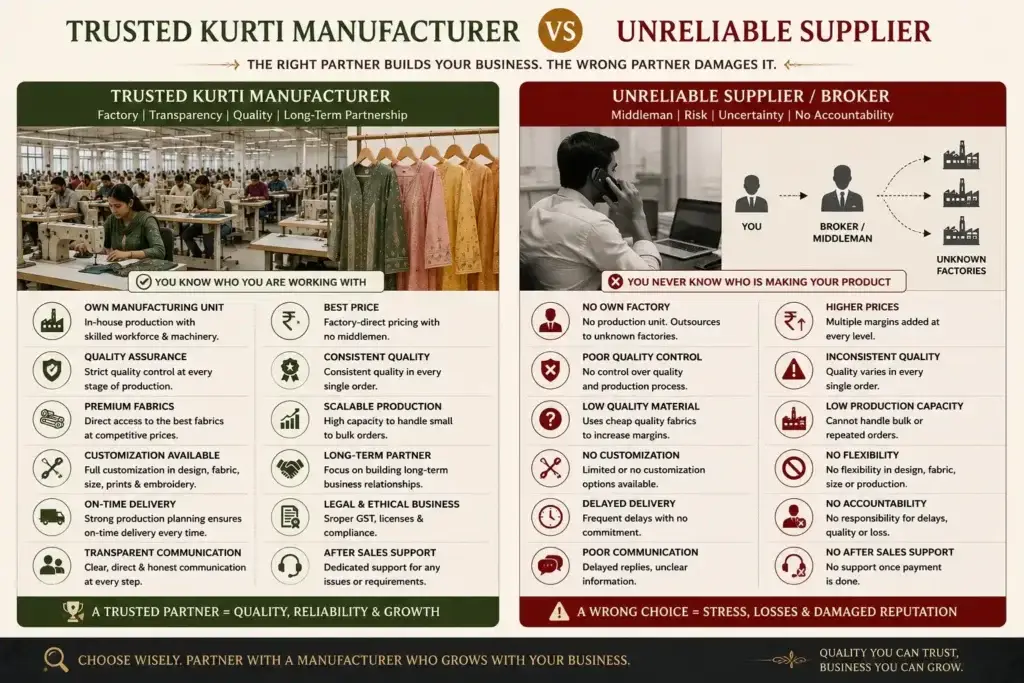
In the kurti manufacturing industry, these five warning signs consistently appear before the sourcing problems that B2B buyers most frequently describe: rejected batches, missed deadlines, and the discovery that the supplier who took your order was not the one who produced it.
Red Flag: No physical facility or deflected factory visit requests. Any legitimate kurti manufacturer in India welcomes a facility visit or video audit. A supplier who consistently redirects or invents reasons why this is not possible is almost certainly not manufacturing your order themselves.
Red Flag: Pricing significantly below market rate for the stated quality. In kurti manufacturing, price reflects production cost. A quote that is 30 to 40 percent below comparable kurti manufacturers in India for the same fabric and construction is almost always a signal of raw material substitution, quality compromise, or a broker misrepresenting themselves as a direct factory.
Red Flag: Sample quality that does not carry through to bulk production. This is the most frequently reported problem in Indian kurti sourcing and the most financially damaging. The sample is prepared with care; the bulk order is produced under standard production conditions. Always specify in your purchase order that bulk quality must match the approved sample within defined tolerances, and build a quality check into every delivery receipt process.
Red Flag: Vague or deflected answers to specific technical questions. A kurti manufacturer in India who cannot tell you their monthly production capacity, their fabric sourcing process, or their QC rejection rate is operating without the systems a serious long-term B2B relationship requires. Vagueness is not modesty. It is the absence of process.
Red Flag: No written documentation provided at any stage. Legitimate kurti manufacturers in India issue written quotations, purchase order confirmations, sample approval records, and dispatch documents as a matter of standard operations. A supplier who operates only through verbal agreements and informal messages has no documentation that can hold them accountable when problems arise.
The most expensive sourcing mistake in the kurti industry is not the one made on price. It is the one made on verification. One poorly chosen manufacturer costs more in lost time, rejected stock, and damaged client relationships than a year of careful evaluation would have required.
Which Type of Buyer Are You? Matching the Right Manufacturer to Your Business
Boutique Owners
Boutique owners need kurti manufacturers in India who support flexible minimum order quantities, offer a wide and regularly updated design range, and can supply consistent quality on repeat orders without requiring a large per-season commitment. Ready-to-dispatch collections are particularly valuable for boutiques, as they allow rapid response to customer demand without long lead times.
Geetha Textile’s kurti collection includes RTD options with 24 to 48-hour dispatch from Surat, making it one of the most practical kurti manufacturer choices for boutique buyers who need to replenish fast-moving styles quickly and reliably.
Wholesalers and Distributors
Wholesalers require kurti manufacturers in India who offer high-volume production capability, stable pricing across large orders, and consistent quality across multiple batches of identical designs. Batch-to-batch consistency is the single most critical requirement for wholesale buyers, and it is only achievable with a vertically integrated, in-house manufacturing operation where quality control is applied uniformly across every production run.
With 1 million-plus metres of fabric produced annually and a 60,000 square foot integrated facility, Geetha Textile is built for the production volumes wholesale buyers require, with the quality control infrastructure to maintain standards consistently across every order.
Online Sellers and D2C Fashion Brands
Online sellers and D2C brands need kurti manufacturers in India who understand the importance of photography-ready finishing, consistent sizing across batches, and the fast design cycles that digital-first brands operate on. They also increasingly require private label support, with production under their own brand name, their labels, and their packaging specifications.
Geetha Textile’s trend-responsive design team and custom fabric development capability supports D2C brands who require exclusive kurti designs produced under their own label. Contact us through our authorised partner programme for private label manufacturing enquiries.
Garment Exporters
Exporters require kurti manufacturers in India who have export documentation experience, compliance with international quality standards, packaging suited to overseas retail presentation, and production timelines that accommodate export logistics and customs clearance. Quality certifications are frequently mandatory for export buyers, and the ability to produce accurate compliance documentation alongside the garments is non-negotiable.
Geetha Textile currently supplies buyers across 12-plus countries and maintains the certifications and compliance standards that international wholesale and export buyers require. Our export experience covers South Asia, Southeast Asia, the Middle East, and markets beyond.
Why Geetha Textile Is the Kurti Manufacturer India's B2B Buyers Choose
Geetha Textile was founded in Surat in 1997, which means we have been manufacturing Indian ethnic wear through every cycle of the industry’s growth, disruption, and evolution for over 25 years. Our client base of 500-plus regular buyers across wholesalers, boutiques, and garment exporters is not a marketing claim. It is the result of meeting every commitment we make, order after order, across more than two decades of manufacturing.
Our manufacturing operation is a fully integrated fibre-to-fashion facility in Sayan, Surat, covering 60,000 square feet. Every production step, from fabric sourcing to finished garment, happens under our roof and within our quality control system. This vertical integration is the structural foundation that makes our quality consistency, pricing transparency, and delivery reliability possible. When you place an order with Geetha Textile, there is no intermediary between your specification and our production floor.
Our product range covers the full ethnic wear spectrum relevant to India’s B2B market: kurtis across all styles and fabric types, sarees including festive and occasion wear, suits for everyday and formal applications, and co-ord sets for contemporary fashion-forward buyers.
Our in-house design team has developed 5,000-plus fabric designs across ethnic categories and releases trend-aligned collections seasonally. Our Ready-to-Dispatch inventory gives time-sensitive buyers access to pre-quality-checked stock that ships within 24 to 48 hours. Our custom development service allows buyers with unique design requirements to work directly with our production team, from concept briefing through to bulk-ready finished garments.
Every partnership at Geetha Textile begins with clear written terms and a sample approval process before bulk production starts. We do not take shortcuts in documentation or quality verification. Our 25-plus years of repeat client relationships are built on the consistency that those standards produce.
Conclusion: One Right Partnership Changes Everything
The kurti manufacturing market in India offers B2B buyers an extraordinary range of sourcing options and an equally significant range of risk. The seven evaluation criteria in this guide, combined with the red flags section and the segment-specific sourcing guidance, give you the framework to navigate that landscape with precision rather than guesswork.
The buyers who build strong and profitable sourcing operations are not the ones who found the cheapest price. They are the ones who evaluated carefully, verified thoroughly, and built a relationship with kurti manufacturers in India who deliver consistently, communicate honestly, and grow alongside their business goals.
Geetha Textile has been that manufacturing partner for 500-plus buyers across India and 12-plus countries for over 25 years. If you are building or scaling a kurti sourcing operation in 2026, we would welcome the opportunity to support your business.
Partner with Geetha Textile — India's Trusted Kurti and Ethnic Wear Manufacturer Since 1997
25+ Years | Surat, Gujarat | Fibre-to-Fashion Facility | 60,000 Sq Ft | 500+ Clients | 12+ Countries | 5,000+ Designs Kurtis | Sarees | Suits | Co-ord Sets | Custom Design | Private Label | Ready-to-Dispatch in 24 to 48 Hours Wholesale | Boutique Supply | Export | D2C Brand Manufacturing | Trend-Driven Seasonal Collections
Enquire Now: geethatextile.com/contact-us/ | +91 99090 02028 | geethacreation52@gmail.com
Frequently Asked Questions
Reliable kurti manufacturers in India are primarily concentrated in Surat, Jaipur, and Kolkata, with Surat being the dominant hub for synthetic and printed ethnic wear. Key indicators of reliability include in-house manufacturing capability, a verifiable physical facility, written quality and pricing documentation, and references from existing B2B clients across multiple orders. Geetha Textile, founded in Surat in 1997, is one of India's most established ethnic wear manufacturers with 500-plus regular B2B clients and 25-plus years of consistent supply.
Minimum order quantities vary significantly across kurti manufacturers in India. Large integrated mills may require 1,000 pieces or more per design. Mid-size Surat manufacturers such as Geetha Textile offer flexible MOQ structures, including Ready-to-Dispatch inventory with no minimum for select styles. Always confirm MOQ per design and per collection before beginning any serious supplier conversation, as misaligned expectations at this stage are one of the most common reasons B2B sourcing relationships fail early.
Request the supplier's manufacturing facility address and arrange a physical or video walkthrough. Ask for their monthly in-house production capacity and details of their stitching machinery. Check their GST registration, as a manufacturing entity registers differently from a trading entity. Request references from existing B2B clients who have placed multiple bulk orders and can speak to quality consistency across batches, not just a first sample order.
Surat processes approximately 40 percent of India's synthetic fabric output and is home to the most vertically integrated ethnic wear manufacturing cluster in the country. Kurti manufacturers in India based in Surat benefit from direct material access, specialised design and craft expertise, faster production cycles, and a complete supply chain from fabric to finished garment within a single geographic cluster. For kurti and ethnic wear sourcing, Surat offers structural production and pricing advantages that no other Indian city currently matches.
Yes. Many established kurti manufacturers in India offer private label and custom design services. Geetha Textile's custom development programme supports buyers from initial concept briefing through to sample approval and bulk production under the buyer's own brand label. Confirm that any manufacturer you approach for custom work has a documented intake process, an in-house design capability, and a clear sample approval stage before bulk production begins.
Geetha Textile's Ready-to-Dispatch collection consists of pre-produced, quality-inspected ethnic wear available for immediate dispatch from our Surat warehouse within 24 to 48 hours. Select RTD items carry no minimum MOQ, making them directly accessible for boutique buyers who need to replenish fast-moving designs quickly without committing to full custom production runs. Contact our team for the current RTD catalogue and stock availability.
Geetha Textile is a full-range Indian ethnic wear manufacturer supplying kurtis, sarees across festive and daily wear categories, suits including salwar suits and dress materials, and co-ord sets for contemporary fashion buyers. All categories are available for wholesale supply, boutique orders, export, and private label production from our integrated fibre-to-fashion facility in Surat.